How to Maximize Your Medical Practice Valuation Before Going to Market

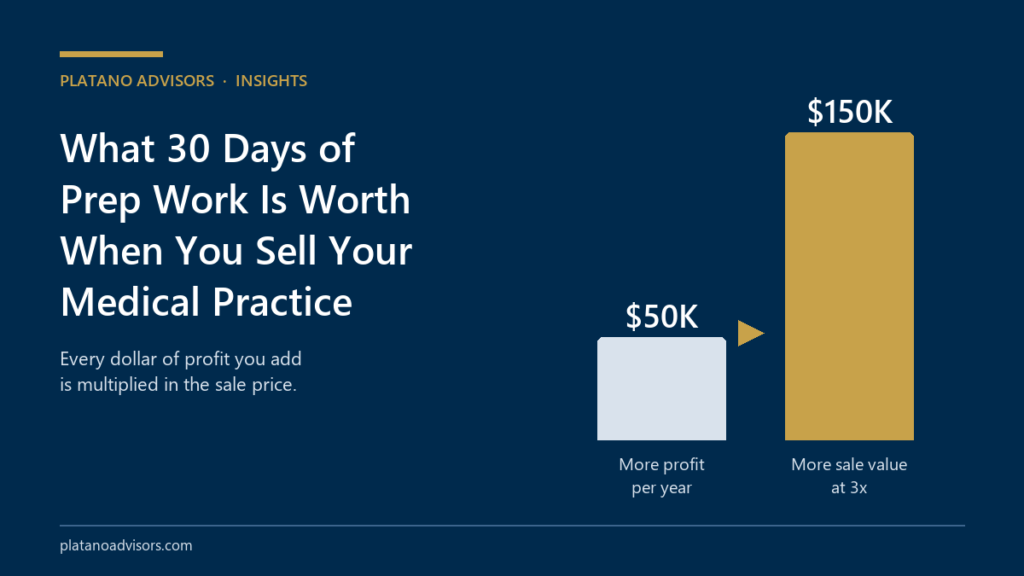
Buyers pay a premium for practices that are clean, scalable, and positioned for growth. Every dollar you invest in strengthening these areas before going to market returns six to ten times at closing. Whether you are a solo provider or a multi-provider group, the fundamentals of valuation remain the same: predictable revenue, operational excellence, and a practice that can thrive through an ownership transition.

What Buyers Are Actually Looking For

โœ… What Buyers Love ๐Ÿšซ What Kills Your Multiple
Multiple providers distributing clinical revenue Owner generates 100% of revenue AND no VBC or recurring contracts
Value-based care contracts and capitation High Medicaid/Medicare-only payer mix with no commercial growth
Strong payer mix (commercial > Medicaid) Messy books with personal expenses run through
Clean EMR hygiene and billing records Undocumented workflows and no SOPs
Loyal, tenured clinical staff No non-compete agreements from key physicians
Documented systems and SOPs Declining patient volume or revenue trends
Geographic expansion potential Pending regulatory issues or audits

The Key Stats That Matter

80%

Recurring Revenue Target

Memberships, capitation, contracts

3+

Providers on Staff

Ideal, but not the only path

5 yr

Clean Financial History

Audited or reviewed statements

Solo Providers: The Nuance Buyers Understand

There is a common misconception that solo providers cannot command strong valuations. That is not entirely accurate. A solo provider with value-based care contracts, strong recurring revenue, clean financials, a well-documented operation, and a loyal patient base attributed under capitation arrangements can still be an attractive acquisition target. Buyers in these cases are acquiring an infrastructure, a patient panel, and a revenue model that can be scaled by adding providers post-close.

Where solo providers struggle is when they combine single-physician dependency with pure fee-for-service revenue. In that scenario, the buyer is essentially purchasing a job that disappears when the physician leaves. There is no recurring revenue to underwrite, no attributed patient panel, and no scalable infrastructure. That combination will result in a significant valuation discount or, in many cases, no competitive offers at all.

๐Ÿ’ก The key takeaway: It is not about being solo versus multi-provider. It is about whether your practice has the structural elements โ€” VBC contracts, recurring revenue, clean books, documented systems โ€” that make it valuable regardless of who owns it. Build those elements, and buyers will compete for your practice.

When to Start Preparing

Start twelve to eighteen months before you plan to sell. That gives you time to make the structural improvements that move the needle on your multiple: cleaning your financials, building recurring revenue streams, pursuing VBC contracts, documenting your operations, and if possible, hiring associates to distribute clinical revenue. Every month of preparation translates directly into dollars at the closing table.

Ready to assess your practice’s sale-readiness?

Schedule a Confidential Call with Platano Advisors

you may also like

stay Connected!

Sign up to receive the most recent opinions and insights from Platano Advisors regarding the revenue cycle business.