Two medical practice owners call me in the same month. Both run primary care. Both clear about $400,000 in profit after we normalize the books.
One sells for roughly $1 million. The other sells for roughly $1.8 million.
Same specialty. Same profit. An $800,000 difference in what they walk away with.
Owners almost always assume a gap like that comes down to negotiation, or timing, or finding the one buyer who overpays. It does not. It comes down to two numbers, and most medical practice owners only ever think about the first one.
The first number: how big you are
Size sets the range. This is the part most owners already have a feel for, even if they have never seen it written down.
A single-provider practice trades in one range. A small group with a few providers trades higher. A mid-sized group trades higher again. A platform with real scale trades in a range that solo owners find hard to believe. I broke those ranges down in detail in what your practice is actually worth, and the logic behind them is simple: bigger practices are less fragile, so buyers pay more for each dollar of profit.
Here is the thing about the first number. You cannot change it before Tuesday. Size is the product of years of decisions. If you are a solo owner planning to sell in the next eighteen months, your group is already set.
Which is why the second number is the one worth your attention.
The second number: how much of your profit survives without you
Buyers are not really buying your profit. They are buying the probability that your profit still shows up after you stop showing up.
That probability is what moves you inside your range. It is the difference between the low end and the high end of the same group, and on a real practice it is worth hundreds of thousands of dollars.
We measure it across four things:
Financial profile. Can your numbers be verified? Do the tax returns, the P&L, and the practice management system tell the same story? Is revenue concentrated in one payer or one contract? Buyers discount what they cannot confirm, and they discount hard.
Owner dependency. If you disappeared for ninety days, what happens to collections? If the answer is that the practice quietly stops working, you are not selling a business. You are selling a job that happens to have your name on the door.
Team depth. Are there other providers producing? Is there someone running operations who is not you? A practice with a functioning team without the owner is a fundamentally different asset than one without.
Timing and runway. How much time you have before you need to be out. Runway is leverage. An owner with three years can fix things. An owner with three months takes what the market offers.
The four groups buyers sort you into
Those four dimensions produce a score, and that score puts a practice in one of four groups. This is how buyers rank practices, and the multiples below reflect solo and small practices, which is most of who we work with. Larger groups price above this table.
Pre-Market (0 to 39). Roughly 2.0x to 3.0x.
Not yet a serious sale candidate. The profit is real but it is welded to the owner, or the books cannot survive a buyer’s accountant. Nothing here is permanent. Every gap is fixable with runway, and owners who spend that runway well often move up two groups.
Foundation (40 to 59). Roughly 3.0x to 3.75x.
The bones are there. Real revenue, real patients, a defensible position. What is missing is the infrastructure that lets the practice run without the owner in every room. Twelve to eighteen focused months usually separates a Foundation practice from a market-ready one.
Acquisition-Ready (60 to 79). Roughly 3.5x to 4.25x.
The market will engage, and it will engage at a fair price. This is where most owners stop, because "we got offers" feels like the finish line. It is not. Optimization from here is what decides whether you sell at fair or sell at a premium.
Top of Market (80 to 100). Roughly 4.0x to 5.0x.
Buyers compete. The books are clean, the owner is replaceable, the team produces, and the revenue is not hostage to a single contract. At this level the question stops being whether you can sell and becomes how you extract the premium.
Run the math on that $400,000 practice. At the bottom of Pre-Market it is a $1 million business. At the top of Top of Market it is a $2 million business. Identical profit. The entire difference is risk.
What this means if you are thinking about selling
The instinct most medical practice owners have is to wait for a better market. Rates, buyer appetite, what the practice down the street got last year.
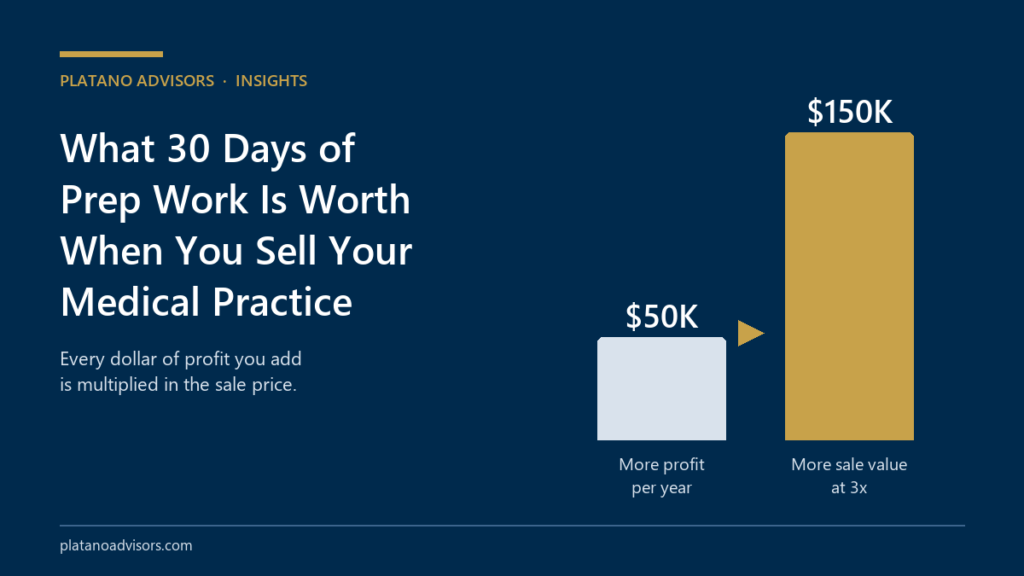
That instinct is backwards. The market moves your ranking a little. Your own preparation moves you into a different group, and that is a far bigger number. An owner who spends a year reducing dependency and cleaning up financials will beat an owner who spends that same year waiting for conditions to improve. Every time.
The other reason to know where you rank early: it changes what you should be doing right now. A Pre-Market owner and an Acquisition-Ready owner should not be running the same playbook. One needs eighteen months of construction. The other needs a competitive process and someone who knows how to run one.
And knowing your number ahead of time is what keeps a deal from unraveling later. The gaps that rank you lower are the same gaps a buyer finds in diligence, except then they surface as a retrade instead of a project plan. That is worth understanding before you sign anything, which is why I wrote about what actually happens after you sign the offer and what you actually keep when you sell.
Find out where you land
We built a scorecard that runs the same four dimensions we use on live deals. It takes about two minutes. You get a score out of 100, where you rank, an estimate of your profit, and the full per-area breakdown on screen.
It is free and there is nothing to install.
If you would rather just talk it through, book a call and we will look at your situation directly.