Signing the offer feels like the end of something. You’ve spent months in quiet conversations, and a buyer has finally put a number in writing. The relief is real. It’s also the exact moment a lot of sellers mentally check out — right as the part that actually decides your outcome is about to start.
Almost everything that determines whether you close, and whether you close at the number you agreed to, happens after you sign. I’ve walked more than 134 practice owners through this stretch. The ones who get burned are almost always the ones who thought the hard part was already behind them.
Here’s what that signature really sets in motion.
(Quick note on wording: your attorney and the buyer will call this document a Letter of Intent, or LOI. I call it the offer, because that’s what it is — a buyer telling you what they’ll pay, and how.)
You just went off the market
Most of the offer is non-binding. Price can still move, terms can still change. But one clause almost always binds you the second you sign it: exclusivity. For the next 60 to 90 days, you’ve agreed to stop talking to every other buyer.
Sit with what that does to your leverage. Until now you had a room full of interested parties and the freedom to walk away from any of them. Now it’s you and one buyer — a buyer who’s about to spend real money on lawyers and accountants to take your business apart piece by piece. The number on that offer is a ceiling, not a floor. Diligence can hold it or shave it down. It almost never raises it. So everything you do from here is about protecting the number you already have.
Which is exactly why the structure of the deal has to be settled before you sign, not after.
Get the structure spelled out in the offer — before you sign it
This is the mistake that costs sellers the most, and I want to be blunt about it.
The top-line number is not the money you’re getting. It’s the money you’re getting if everything breaks your way. What you actually walk away with depends entirely on structure: how much is cash at close, how much sits in escrow, how much is an earnout you only collect if the practice hits targets after you’ve handed over the keys, how much is equity you’re rolling into the buyer’s larger company, and how much is a seller note where you’re financing your own sale.
I’ve watched an owner sit down at the closing table, do the math for the first time, and realize that more than half of their “sale price” wasn’t hitting their account that day. Some of it wasn’t coming for years. Some of it wasn’t guaranteed at all. That’s a brutal moment to have in front of a room full of lawyers, and it’s completely avoidable.
All of it has to be laid out, clear as day, in the offer itself — and fully hashed out before you put your name on it. Once you’ve signed and the exclusivity clock is running, you’ve handed away most of the leverage you’d need to renegotiate any of it. “I sold for six million” means one thing when it’s six million wired at close, and something very different when three of it is deferred. Make sure you know which deal you’re actually signing. (Not sure what your number should even be yet? That starts with an honest valuation — here’s what your practice is actually worth in 2026.)
Then the buyer opens the books
Within days of signing, the requests start coming. They’ll fall into a handful of buckets — the seven below cover most of what any buyer asks for.
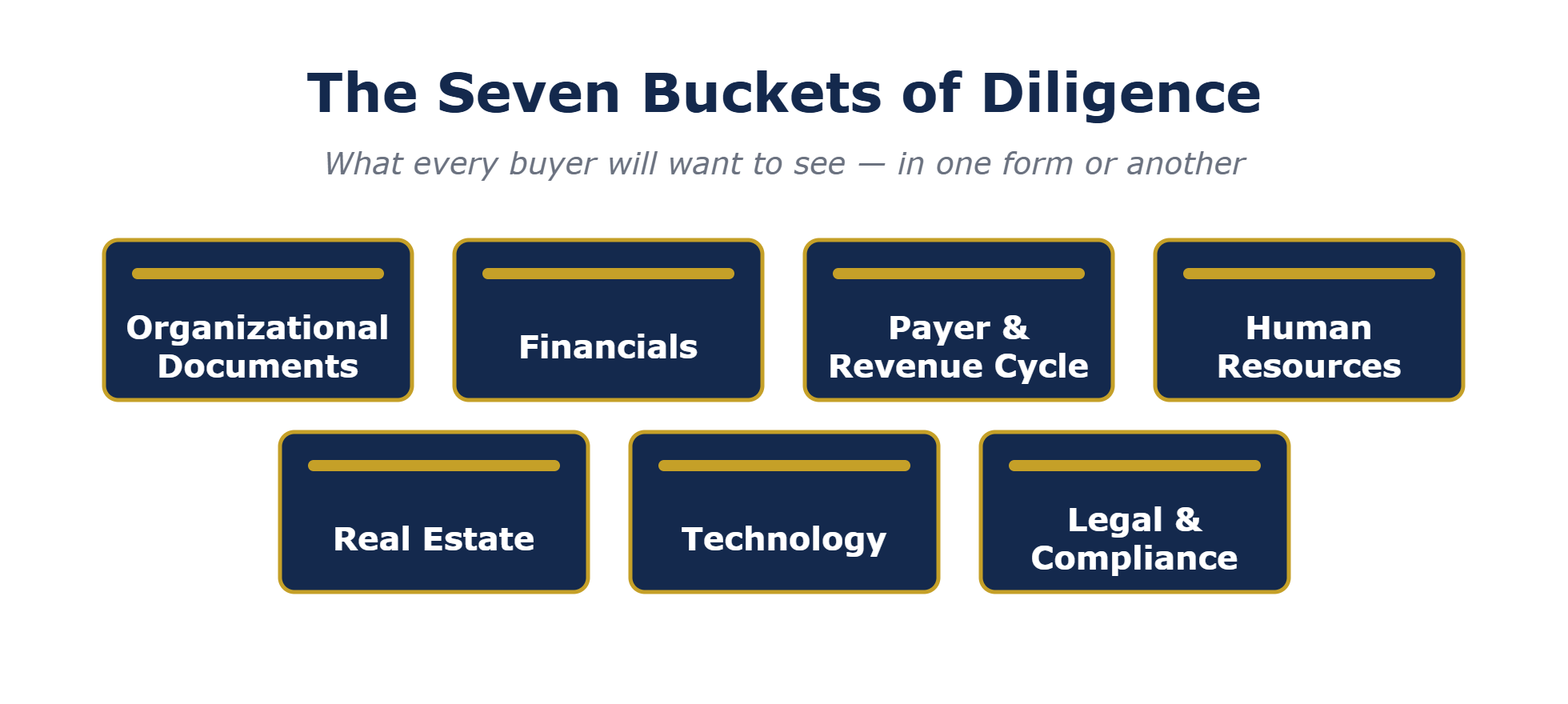
Now, here’s something that runs against the usual advice: you don’t need to build the perfect data room before you go to market, because there’s no such thing. Every buyer wants the information sliced a little differently, and you’ll make yourself crazy trying to anticipate a request list you can’t see yet.
What actually matters is how you respond once the requests land. And this is where sellers quietly sabotage their own deals. In my experience, transactions stall on the sell side more often than the buy side, and it’s almost always the same cause: the seller is slow getting information over. A buyer’s team left waiting two weeks for documents starts to wonder what’s taking so long — whether the numbers are shakier than they looked, whether they should revisit the price. Momentum is a real asset in a deal, and nothing drains it faster than a seller who treats document requests as a back-burner task. Be flexible about how you package things, stay organized, and turn requests around fast. That one habit protects your price about as well as anything you can do.
Quality of Earnings: where the number quietly moves
Somewhere in those first weeks, the buyer brings in accountants to run a Quality of Earnings review. In plain terms, they rebuild your profit from the ground up to test whether it’s really there.
Every add-back gets a hard look. The car you ran through the business. The “one-time” expense that somehow showed up three years running. The relative on payroll who doesn’t quite earn the salary. Each one they disqualify pulls a cost back onto your books and lowers the earnings your price was built on. This is rarely a dramatic renegotiation. It’s a slow leak, one line item at a time.
The way to defend against it is to know your own defensible number before you ever sit across from their accountants. A lot of my clients run their own Quality of Earnings first, so when the buyer’s team pushes, they’re defending a position they’ve already tested — not finding out about a problem in real time.
The offer becomes a real contract
While diligence runs, the lawyers turn your offer into the definitive agreement, which is the binding purchase contract. This is where the real fight happens, and it usually isn’t about price. It’s about reps and warranties, how long you stay on the hook after closing, how much of your proceeds sit in escrow as the buyer’s safety net, and the working capital true-up that quietly moves money at the table.
First-time sellers stare at the purchase price and skim everything underneath it. That’s backwards. Two deals at the identical headline price can be hundreds of thousands of dollars apart once you read the terms. The buyer’s lawyers know that. Yours had better, too.
The healthcare wrinkle that slows everything down
Here’s what makes selling a practice different from selling almost any other business: you can’t just hand over the keys.
A healthcare sale drags a stack of regulatory transfers behind it — payer re-credentialing, licensure and NPI updates, DEA registration, and change-of-ownership notices to Medicare and Medicaid. Skip a step and the new owner can’t bill on day one, which means the practice you just sold stops generating money at the worst possible time. This is the single most common reason healthcare deals run longer than everyone expected at signing. It’s also the most preventable, as long as someone on your side is mapping it out early instead of discovering it the week before close.
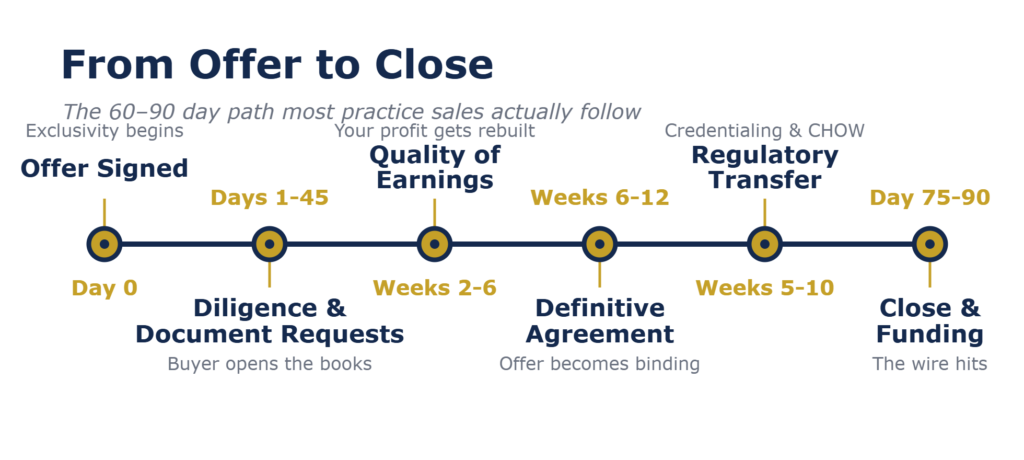
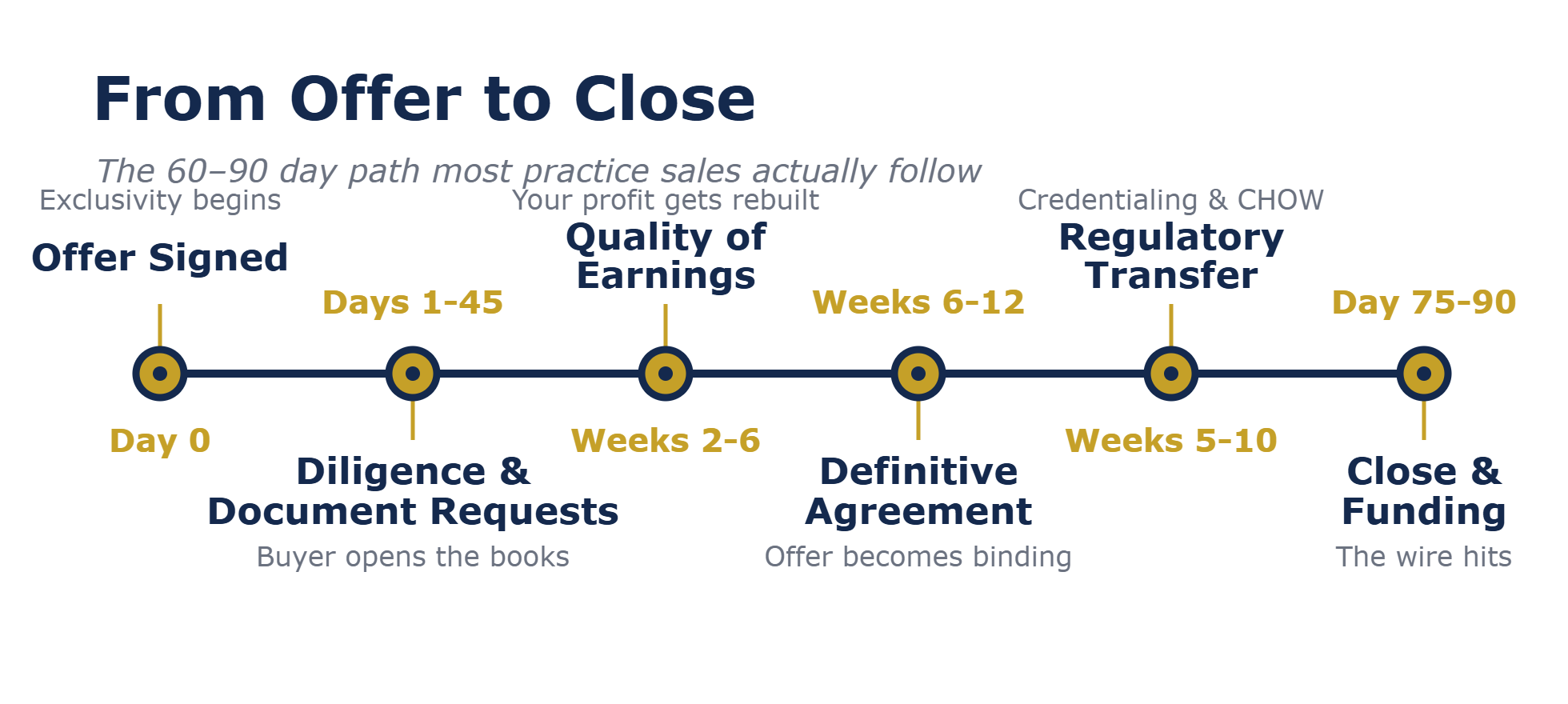
Here’s the shape of the whole path, from the day you sign to the day the wire lands.
Keep running the practice like you’re not selling it
Nobody warns you about this part, and it’s exhausting. You have to keep the practice performing while you sell it, and diligence is basically a second full-time job dropped on top of the one you already have.
The temptation is to let operations coast while you answer document requests at midnight. Don’t. A soft quarter in the middle of diligence is an open invitation for the buyer to come back and re-trade you.
Re-trades, and how to beat them
A re-trade is when the buyer circles back late in the process and tries to lower the price you already agreed to. Sometimes they found something real. Sometimes they just sense you’re committed, off the market, and unlikely to walk away after two months of work.
You don’t beat a re-trade with outrage. You beat it by never handing them the opening in the first place. After 134 of these, I can usually feel one forming weeks before it lands. Here are the ones I see most, and what actually stops them.
| What triggers a re-trade | How you beat it |
|---|---|
| Your earnings don’t survive Quality of Earnings; add-backs get rejected | Know your defensible EBITDA before you go to market; run your own sell-side QoE first |
| Performance dips in the middle of diligence | Keep operating at full strength — don’t let the practice drift while you sell it |
| Slow, disorganized document delivery signals trouble | Respond fast and completely; momentum is leverage |
| The buyer senses you’re committed and off-market | Keep the process competitive as long as you can; let your advisor hold the line |
| A real problem surfaces late (undisclosed liability, a shaky contract) | Disclose early — a known issue costs far less than a late surprise |
| The buyer’s financing or thesis shifts under them | Vet the buyer’s funding and seriousness before you ever grant exclusivity |
Then you close
When diligence clears, the agreement is signed, and the regulatory pieces line up, you close. Documents get executed, funds get wired, and the handoff begins — usually with you staying on for a stretch to transition patients and staff.
The wire hitting your account is the finish line. Not the offer you signed two months earlier.
What actually separates the clean closes
The owners who reach the table at their number aren’t the lucky ones. They settled the structure before they signed, so nothing about the deferred money surprised them at close. They answered diligence fast enough to keep the deal moving. They knew their real earnings before anyone challenged them. And they held the line all the way through.
The offer isn’t the win. It’s permission to start the real work — and how you handle the sixty days after it decides everything.
If selling is anywhere on your horizon, even a year or two out, the smartest moves are the ones you make while you still hold the leverage. That’s the work we do at Platano Advisors: getting practices through diligence intact, and holding the number all the way to the wire. If you want the full playbook before you get there, our free guide — How to Sell Your Medical Practice — walks the entire process end to end.
Frequently asked questions
How long does it take to close after you sign the offer?
For most practice sales, 60 to 90 days from signed offer to funded wire. Healthcare deals tend to sit at the longer end because of the regulatory transfers — credentialing, licensure, and change-of-ownership filings — that other industries don’t deal with.
Why is the price in the offer different from what I actually receive?
Because the top-line number is rarely all cash at close. It’s usually a mix of cash, escrow held back for a year or two, an earnout you only collect if the practice performs after the sale, and sometimes equity rollover or a seller note. That’s why the structure has to be spelled out in the offer before you sign, not discovered at closing.
What is a Quality of Earnings review?
It’s when the buyer’s accountants rebuild your profit from the ground up to confirm your earnings are real. They scrutinize every add-back, and anything they disqualify lowers the earnings your price was based on. Knowing your own defensible number in advance is the best protection.
Why do healthcare practice sales take longer to close?
Ownership of a practice can’t simply be handed over. Payer re-credentialing, NPI and licensure updates, DEA registration, and Medicare/Medicaid change-of-ownership notices all take time, and missing one can stop the new owner from billing on day one.
What is a re-trade, and how do I avoid one?
A re-trade is when a buyer tries to lower the agreed price late in the process. You avoid it by keeping the practice performing, responding to diligence quickly, and having an advisor who protects the number when pressure hits.
Pedro Rojas | Platano Advisors
Sell-side M&A for healthcare founders. 134+ closed transactions, $1B+ in deal value, 8,000+ healthcare-specific buyers.
📧 pedro@platanoadvisors.com · 📞 786-882-1095
How long the regulatory stretch runs depends on what you practice. The transfer path is different when you sell a primary care practice, where payer enrollment and panel continuity drive the timeline, than when you sell a dental practice.
Keep reading
- What you actually keep when you sell
- How to crush buyer objections
- The sale process, start to finish
New to this? Start with How to Sell a Medical Practice, our complete guide, or see how we run a sale at Platano Advisors.