If you own your medical practice and the building it operates from, you own two assets, and selling them is two transactions. They can be done at the same time or years apart, to the same buyer or to two different ones. Each combination changes what you get for each asset and how much risk you carry in between.
This guide walks through what to do: how the two sales differ, why selling them together can raise what a buyer pays, when it does not, the ways they can be combined, and what has to be in place so each one supports the other. It also includes our recommendation on the order, which is the question we get asked most.
Two assets, two transactions
The practice sale and the real estate sale are different deals, even when they close on the same day.
They are priced differently. A medical practice is valued on its earnings. A medical office building is valued on the rent it produces, or, if it has no tenant, on its square footage and what a buyer thinks it would cost to convert.
They are financed differently. A loan to buy a practice is underwritten on the practice’s cash flow. A loan on the building is underwritten on the lease. Under the SBA 7(a) program, a loan for the practice alone amortizes over a maximum of 10 years, while the real estate portion can run up to 25 years, and if 51 percent or more of the loan goes to the real estate, the entire loan can run 25 years.
They attract different buyers. Physicians buy practices. Some of them also want to own the building. Strategic buyers, the groups acquiring several practices, generally lease. Real estate investors buy buildings, and what they want is a building with a tenant in place.
They are taxed differently, and if the building is held in a separate entity from the practice, as it often is, that entity is a second seller with its own contract and its own closing. Your CPA should be in the conversation before either asset is listed.
Why selling the medical practice with the real estate can raise the price
The case rests on one lending fact: longer amortization means a lower payment for every dollar borrowed.
When one loan covers both the practice and the building, the lender blends the 10-year and 25-year terms by the share of the loan going to each. As an illustration at a 10 percent rate, a $1,000,000 loan costs about $158,600 a year on a 10-year schedule and about $109,000 a year on a 25-year schedule. The same cash flow carries roughly 45 percent more debt at 25 years. A blended loan lands somewhere between the two.
That does three things for the buyer:
- Lower monthly payments. The practice’s cash flow covers debt service with more room to spare, which is exactly what the lender’s coverage test is looking for.
- A higher price becomes fundable. Because the payment is lower per dollar borrowed, the buyer can support a larger loan on the same earnings. That is what allows the seller to ask for more and still find a buyer who can close.
- Control. The buyer owns the walls. No rent escalations, no landlord who can decline to renew, no risk of losing the location the patients know. Every payment builds equity.
And it does three things for you:
- A higher total number. If the buyer’s payment is lower, the buyer can pay more, and you capture part of that difference.
- No accidental landlord. Many medical practice owners sell the practice and keep the building “for the income.” Then the new owner’s practice struggles, relocates, or asks for rent relief, and the retirement asset becomes a management problem. A purpose-built medical suite is expensive to sit empty and expensive to convert.
- A clean break. When both assets transfer, you are done. No tenant calls, no roof, no property tax appeals.
When selling both together does not work
Selling both to one buyer is a good idea in general. It is not always a good idea.
There are fewer buyers at the combined number. A physician buying a practice for $1.2 million is a large pool. A physician buying a practice and a building for $2.7 million is a smaller one. Strategic buyers generally do not want to own real estate at all. Bundling shrinks the buyer pool and usually lengthens the timeline. It can still be the right move, but go in knowing that.
The building is worth more than the practice can carry. If market rent on your building is higher than the practice’s earnings can support, the bundle penalizes one asset or the other. In that case the two go to different buyers: the practice with a lease it can afford, and the building to a real estate investor with that lease attached.
You genuinely want the rental income. A long, well-written lease to a strong tenant is a legitimate retirement asset. If that is your plan, the lease is drafted for that purpose from the start.
Taxes. Depreciation recapture, capital gains treatment, and the option of a like-kind exchange on the real estate all change the after-tax answer. Talk to your CPA before you decide how to package the sale, not after the offer is signed.
The ways the two sales can be combined
There are more combinations than most medical practice owners expect.
- One buyer, one closing. The practice buyer also buys the building, and both transfer together.
- One buyer, two closings. The practice buyer signs a lease at closing and buys the building later, sometimes under an option written into the lease.
- Two buyers. The practice goes to one buyer, who becomes the tenant. The building goes to a real estate investor with that lease attached.
- Sell the practice, keep the building. The practice buyer becomes your tenant and you hold the building for the rent.
- Building first. The building is sold to an investor and leased back, and the practice is sold afterward.
Which of these you end up in depends partly on the buyer who shows up. What you control is the order you go to market in, and that is where the recommendation comes in.
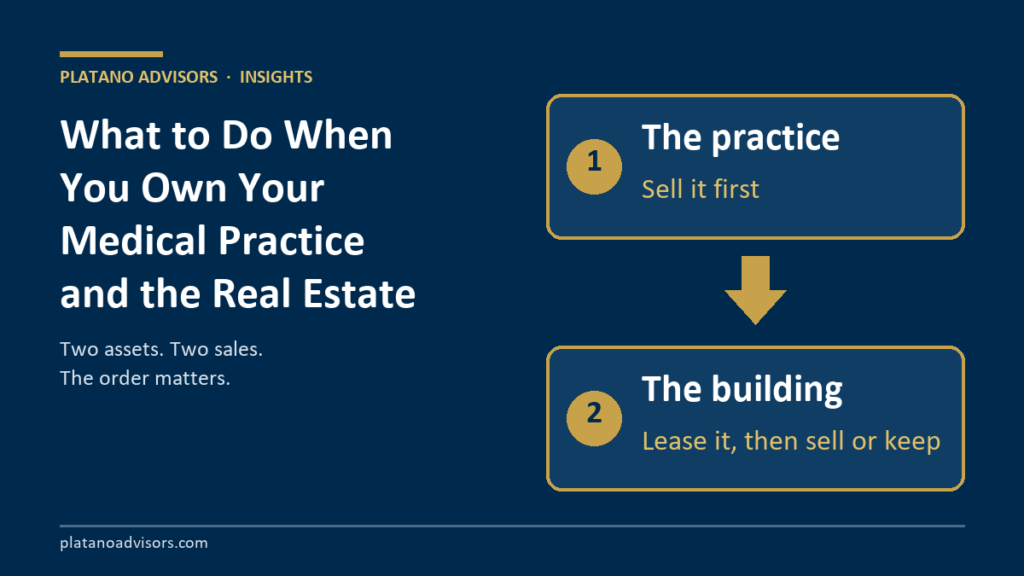
Our recommendation: sell the practice first, or both together. Not the practice after the building.
Sell the medical practice first, then the building. Or sell both to the same buyer in one transaction. What we do not recommend is selling the building first and the practice afterward.
The practice is the slower sale, so it goes first. Finding, qualifying, and closing a buyer for a medical practice takes longer than selling a leased building. There is a valuation to build, a confidential marketing process to run, buyer interviews, a letter of intent, diligence, financing, and the credentialing and payer work that has to be timed around closing. A medical office building with a tenant in place is a more standard asset that real estate investors underwrite on the lease.
You keep control of the building while the practice sells. No landlord has been introduced, no lease has been signed by anyone but you, and nothing about the real estate is fixed before you know who the practice buyer is. You are selling the harder asset from the strongest position you will ever hold.
The practice sale produces the tenant the building needs. Whoever buys the practice is going to occupy your building, either as its new owner or as its new tenant. The moment the practice closes, the building goes from an owner-occupied suite with no lease to an income property with a tenant.
Why not the building first. Once the building is sold, you are a tenant, and the terms of your lease were set before you knew who would buy the practice. The practice buyer inherits that lease, and the new landlord usually has a say in the assignment, which puts a third party between you and your practice sale. You have also given up the option of offering the building to the practice buyer, who may have been the best buyer for it. There are structures where the building sells first, and they are used in specific situations. We are glad to talk through them. As a general rule, though, the practice does not sell after the building.
Step 1: Sell the practice, and offer the buyer the building
List the practice and run the full buyer process. Every serious buyer is offered the building as well.
Why a practice buyer may want it. Financing. A loan that covers both amortizes over a longer schedule than a practice-only loan, which means a lower payment per dollar borrowed and more purchase supported by the same cash flow. The buyer also owns the walls: no rent escalations, no renewal risk, and every payment builds equity.
Why a practice buyer may pass. It is a bigger check. Buying both means more equity down and more debt, and some buyers who can comfortably carry the practice cannot carry the building on top of it. Strategic buyers generally do not want to own real estate at all.
So the pool of buyers who will take both is real, but it is smaller than the pool for the practice alone. If the practice buyer takes the building, you close both, and you are done. If not, you lose nothing, because the buyer you just found becomes your tenant, and that is Step 2.
Step 2: If the buyer only wants the practice, they sign a lease at closing
The buyer signs a lease on the building at the practice closing. You become the landlord. The lease does not need to exist before the practice sells; it is created as part of the practice transaction.
The lease is what turns the building into a sellable asset, so it has to be written for two readers at once: the buyer who is signing it, and the real estate investor who may buy the building later.
What the lease needs
- A term long enough to protect the buyer, and firm enough to price. The buyer paid for a practice whose patients know this address. The lease has to give them years of security, with renewal options only they can exercise. An SBA lender will generally require the lease, including those options, to run at least as long as the buyer’s loan. A lease with three years left will stop a financed buyer cold. Investors, on the other hand, pay for firm years, not option years.
- Rent at market. Not what the practice was paying you, and not a number that flatters the building. Rent above market comes straight out of the practice’s earnings, and the buyer’s lender underwrites the actual lease payment. Rent below market cuts the building’s value. Expect the buyer to negotiate rent as part of the practice price. Hold the rent at market and negotiate the price instead. The rent follows you into the building sale. The price does not.
- Assignment with consent. Assignable to a successor practice with the landlord’s consent, which the lease says cannot be unreasonably withheld, with the original tenant staying responsible unless released.
If you plan to stay on with the practice after closing while also being its landlord, the lease has to hold up as a written, fair-market arrangement under the federal physician self-referral rules, so have healthcare counsel review it before it is signed.
We are not attorneys, and nothing in this article is legal advice. The lease is a legal document and should be drafted and reviewed by your attorney. If you need one, we are happy to make an introduction.
Step 3: Sell the building with the tenant in place, or keep it
Selling a medical building with a tenant in place
Investors price a leased building on its income, and a long lease to a medical tenant usually clears a higher price than the same building empty. A vacant medical suite is priced on square footage and the cost of converting a specialized build-out; a leased one is priced on the rent the practice buyer just committed to. The exception is an owner-user, another practice that wants the space for itself. That buyer needs your practice buyer to leave, so it is not a path you want. Whichever way you go, the building goes to market with a lease attached, never vacant and never month to month.
Because the practice sold first, you arrive at the building sale with the tenant in place, the rent set at market, and the income proven. Sell the practice first, and it produces the tenant. The tenant produces the lease. The lease produces the building’s price. Each step sets up the next.
Keeping the building for rental income
You can also sell the medical practice and keep the building. Some medical practice owners prefer the monthly rent to the lump sum, and a long lease to a strong medical tenant supports that. Write the lease to the same standard either way, so the option to sell later stays open.
A middle path is a lease with an option to purchase: the practice buyer leases now and holds a right to buy the building later at a set price or formula. It gives the buyer a route to ownership without the larger day-one check, and it gives you a defined exit from the real estate.
How Platano handles it
Platano Advisors is a full-service healthcare M&A firm and a licensed Florida real estate brokerage, so we can represent you on the practice sale and on the real estate sale, whether they run together or separately. We underwrite both assets before listing, set the rent where the lender’s math and the investor’s math agree, and decide with you which combination fits your buyer pool and your timeline. When the answer is “keep the building,” we say so. Sales where we sell both the medical practice and its real estate are a significant part of the transactions we close. If you own both and are thinking about retirement, we would be glad to talk through what the sequence looks like for your situation.
Frequently asked questions
Should I sell the medical practice first or the building first?
The practice first, or both together to the same buyer. The practice is the slower sale, you keep control of the building while it runs, and the practice buyer becomes either the buyer of the building or its tenant. We do not recommend selling the building first.
Does selling the building with the practice always raise the price?
No. It raises the price a financed buyer can support, because the loan amortizes over a longer period. Whether that shows up in offers depends on whether the buyers in your market want to own real estate. Individual physician buyers often do. Strategic buyers usually do not.
Can the same buyer purchase both the practice and the building with one loan?
Yes. The SBA 7(a) program allows a single loan for both, with a blended maturity weighted by how much of the loan goes to each. The real estate can amortize over up to 25 years versus 10 for the practice alone, and if 51 percent or more of the loan goes to the real estate, the whole loan can run 25 years. The pool of buyers willing to take both is smaller, so the building is offered to every serious practice buyer with the lease path ready behind it.
Can I sell the medical practice and keep the building?
Yes. The practice buyer signs a lease at closing and you hold the building as an income property. Write the lease to investor standard anyway, so you can sell the building later without renegotiating it.
Do I need a lease in place before I sell the practice?
No. The lease is created as part of the practice transaction. The buyer signs it at closing, and the building is then sold or held with that lease attached.
What rent should I put in the lease?
Market rent for comparable medical space in your area. Not what the practice has been paying you, and not what would make the building look most valuable.
What does the buyer’s lender require in the lease?
An SBA lender will generally require the lease term, including renewal options the tenant controls, to run at least as long as the practice loan, at a rent the practice’s earnings can cover.
Should the building be included in the practice’s sale price?
No. Price them separately. The practice is valued on its earnings and the building on its rent, and one blended number lets a buyer discount the asset they understand least. Even when one buyer takes both, the purchase agreement allocates a price to each.
Who buys a medical office building with a lease on it?
Medical office real estate investors, local commercial investors, and sometimes the practice buyer. What they price is the lease: the tenant’s commitment, the firm term and options, and market rent.
How early should I start?
Decide the structure and do the tax planning before you list. The lease itself does not need to exist before the sale. It can be signed as part of the transaction with the buyer of the practice.