
Two medical practice owners sell in the same quarter. Same specialty, similar collections, same market. One tells his golf group he sold for $2.3 million. The other says he sold for $2 million.
Three years later, the one who “sold for less” has $1.8 million in the bank and zero remaining obligations. The one who sold for $2.3 million has collected about $1.5 million, is still waiting on an earnout that will probably pay half, and owns a minority stake in a company he does not control.
Same practice. Same quarter. Completely different outcomes. The difference was never the headline number. It was the structure underneath it.
Almost every conversation I have with a medical practice owner starts with “what is my practice worth.” That is the right question to ask second. The first question is what the money looks like when it actually arrives, because two offers with identical headline numbers can be worth hundreds of thousands of dollars apart.
Here is how deals actually get paid.
The headline number is a menu, not a check
When a buyer says $2 million, they are almost never saying “we will wire you $2 million at closing.” They are describing total potential consideration, and it usually splits across four buckets:
- Cash at close. Wired the day you sign. Certain.
- Seller note. You finance part of your own sale and the buyer pays you back over time, with interest.
- Earnout. Additional money paid only if the practice hits agreed targets after you sell.
- Rollover equity. You keep a minority stake in the acquiring company instead of taking cash for that portion.
Every one of those dollars counts toward the headline number. Only one of them is guaranteed.
That is not a reason to reject structured offers. Structure is how buyers bridge a valuation gap, and a well-built structure can genuinely pay you more than an all-cash deal would have. But you cannot evaluate an offer until you know what percentage of it is real money on day one, and what percentage is a promise.
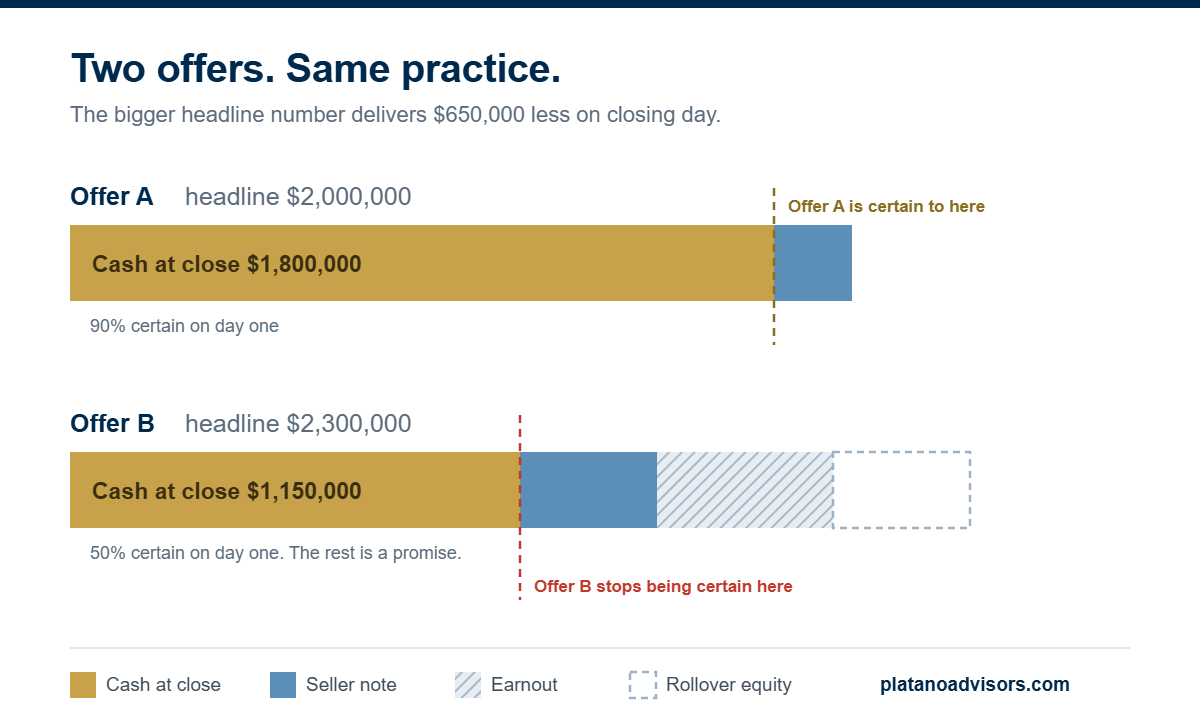
Cash at close is the only number that is certain
This is the number I want medical practice owners anchored to. Not the headline. Cash at close.
In the deals we run, healthy cash at close for a single-provider or small group practice generally lands somewhere between 70% and 90% of total consideration. Larger platforms with institutional buyers skew lower, because those buyers want you financially invested in the next chapter.
When cash at close drops below roughly 60%, that is not automatically a bad deal. It is a signal to slow down and ask why. Sometimes the buyer is protecting against real risk, like heavy payer concentration or a book of business that walks out the door with you. Sometimes the buyer simply does not have the capital and is asking you to fund the acquisition.
Those two situations look identical on paper. They are not the same deal.
The seller note: you just became the bank
A seller note means the buyer pays you a portion of the price over time, typically two to five years, usually with interest somewhere in the mid-single digits.
Two things matter more than the rate.
First, where you sit if the buyer took on bank debt. Lenders almost always require your note to be subordinated, which means if the business struggles, the bank gets paid and you wait. Your note is only as good as the operator running the practice you just handed over.
Second, whether the note has a right of offset. Many do. That language lets the buyer reduce what they owe you if they later claim a representation or warranty was breached. A note with broad offset rights is a claim waiting to happen, and it is one of the quiet ways a closed deal keeps costing you money.
If your buyer is using an SBA loan, your note is not really yours to negotiate
This is the part that catches sellers off guard, and it applies to a large share of single-practice transactions. When the buyer is another physician, or a small group expanding into your market, the purchase is very often financed with an SBA 7(a) loan. The moment that happens, a third party joins your negotiation, and the SBA’s rules override whatever you and the buyer shook hands on.
Under SOP 50 10 8, the SBA’s current operating procedure for the 7(a) program:
- A complete change of ownership requires a minimum equity injection of 10% of total project costs.
- A seller note can count toward that injection only if it is on full standby for the life of the SBA loan. Full standby means no principal and no interest paid to you until the SBA loan is retired. On an acquisition loan, that is typically a ten year wait.
- That standby portion cannot exceed half of the required injection. On a 10% requirement, your note is doing 5% of the work at most.
- If the note is not on full standby, it does not count toward the injection at all. It gets loaded into the buyer’s debt service coverage ratio instead.
That last bullet is where sellers lose money without realizing it. Practically, your note has to behave like the bank’s paper. An SBA acquisition loan amortizes over roughly ten years. A seller note that wants to be paid off in two or three years stacks a heavy payment on top of that bank debt, the debt service coverage ratio fails, and the lender declines the deal or forces your note out to a comparable term. The tidy two year note you negotiated does not survive underwriting.
The standby itself is documented on SBA Form 155, the Standby Creditor’s Agreement. Worth knowing: Form 155 does not subordinate your lien on its own, so expect to sign a separate subordination agreement alongside it.
The tools that get you paid sooner
None of this means you accept a decade of silence. It means you negotiate the right things.
- Split the note into two tranches. Put one small piece on full standby to satisfy the equity injection, and structure the rest as a separate subordinated note that amortizes and pays you currently. Only the standby tranche is frozen. This is the single most useful move available to you.
- Interest only, then amortization. Lower the early debt service so the coverage ratio clears underwriting, then begin principal payments once the practice has settled under new ownership.
- Make interest accrue during standby. If you cannot touch the money for ten years, at minimum get paid for the time value. Accrued interest, paid at maturity.
- Price the standby into the number. A dollar you cannot access for a decade is not worth a dollar today. If the structure requires 5% of your price to sit frozen, that belongs in the headline or in the rate. Say so before you sign.
- Consider a forgivable note tied to a historical metric. Because it references past performance rather than future performance, it can do some of the work an earnout would without being treated as contingent price.
One timing note: the SBA has issued SOP 50 10 8.1, effective October 1, 2026. If your transaction is closing in the fourth quarter or later, have the buyer’s lender confirm the current requirements before you build structure around them.
The earnout: getting paid for a future you no longer control
Earnouts are where the largest gap between headline and reality shows up. The structure sounds fair: hit the numbers, get the money. In practice, you are being asked to guarantee performance in a business you no longer own or direct.
The buyer now controls the staffing, the fee schedule, the payer contracts, the marketing spend, and often the EHR conversion that eats six months of productivity. Any one of those decisions can move the metric your payment depends on.
If there is an earnout in your deal, three things make it survivable:
- Tie it to a number that is hard to manipulate. Gross collections or patient visits beat EBITDA, because EBITDA can be reshaped by allocated corporate overhead you had no say in.
- Get operational protections in writing. No material changes to fee schedules, staffing, or payer participation during the earnout period without your consent.
- Build it to pay in tiers, not cliffs. An all-or-nothing target at 100% of budget pays zero at 99%. A sliding scale pays you for hitting 92%.
Then, when you model your outcome, assume the earnout pays 50%. If the deal still works at that number, it is a real deal. If it only works when the earnout pays in full, you are looking at a lower offer wearing a bigger number.
One important exception: if your buyer is using SBA financing, there is no earnout. SBA 7(a) change of ownership transactions require a fixed, determinable purchase price at a single closing, and earnouts are prohibited. Contingent consideration that is economically deferred purchase price gets recharacterized as seller financing, which drops it right back under the standby rules above. So when a buyer offers you an earnout in the same breath as telling you they are getting an SBA loan, one of those two things is not going to happen. Find out which one now, not in week six.
Rollover equity: the second bite, and what it costs
Rollover is common with private equity backed buyers and larger strategic buyers. You take a portion of your proceeds as equity in the acquiring platform, and when that platform sells again in three to seven years, your stake sells with it.
The pitch is that the second bite can be worth more than the first. Sometimes it genuinely is. Platforms buy your practice at a single-practice multiple and get valued at a much higher platform multiple, and you capture that spread on your rolled shares.
The questions that decide whether it works for you:
- Is your equity in the operating company, or in a holding entity several layers up?
- Is it common stock, or do preferred holders get paid in full before you see a dollar?
- What happens to your shares if you leave, get terminated, or the platform recapitalizes?
- What has this specific buyer’s prior exit actually returned to rolled sellers? Ask for names. Call them.
Rollover is the one bucket where the upside is genuinely uncapped. It is also the one where you have the least control and the least information. Size it to what you can afford to lose, not to what the projection deck says it might become.
Asset sale or stock sale, and why buyers fight for one
Nearly every buyer wants an asset sale. They purchase the practice’s assets and assume only the liabilities they choose, which walls them off from your prior malpractice exposure, billing history, and employment claims.
You often prefer a stock sale, because a single sale of stock is generally treated as one capital gain event rather than being carved up across asset categories at different rates.
This is not a fight you win by arguing. You win it by pricing it. If the buyer insists on an asset sale and that costs you more in taxes, that difference belongs in the purchase price. Bring it up before the offer is signed, not after.
The structure you choose also decides when you close
Here is the part almost nobody prices in, and in healthcare it is often the more expensive half of the decision.
In an asset sale, the buyer is not the legal successor to your entity. They are a brand new business that happens to occupy your suite and see your patients. Everything that made your practice able to collect money has to be rebuilt from scratch in the buyer’s name:
- A new legal entity, and in many states a professional entity that can only be owned by a licensed physician
- State facility and business licensure
- A new NPI, and DEA registration for each location
- A CLIA certificate if you run any in-office lab
- A brand new Medicare enrollment, filed on CMS Form 855B for the group, with 855I and 855R filings for the providers
- Medicaid enrollment, which runs on its own state-by-state timeline entirely separate from Medicare
- Commercial payer contracting and credentialing, every payer, one at a time
The timelines are not trivial. A new Medicare enrollment application generally takes 60 to 90 days to process, and until it is approved the new entity cannot bill Medicare under its own number at all. Commercial credentialing is the long pole, routinely 90 to 180 days, longer if a panel is closed.
So an asset deal in healthcare has a gap in it: a stretch of months where the practice is producing but the new owner cannot bill for it. Deals resolve that gap one of two ways. Either the closing itself gets pushed out until the enrollments come through, which is how a 90 day process becomes a six month one, or the parties bridge it with a temporary billing or management arrangement where claims continue to go out under your entity and your number while the buyer’s applications work through the queue.
Understand what that bridge actually asks of you. Your entity, your NPI, and your liability stay in the billing chain for months after you thought you were finished. You are lending your license to someone else’s revenue cycle. Read that agreement with the same care you give the purchase agreement, and get paid for it.
A stock sale largely sidesteps all of it. The entity survives the transaction, so the provider numbers, payer contracts, and enrollments generally ride along with a change of ownership notification instead of a rebuild. It is not free either. Check your payer contracts and your lease for change of control clauses, which can require consent and create delays of their own.
The honest tradeoff: an asset sale is usually better for the buyer’s taxes and liability, a stock sale is usually better for yours and almost always faster to close. When a buyer insists on an asset structure, the right response is not only “then pay me more.” It is “then let’s agree right now on who carries the cost of the ninety days when nobody can bill.”
The allocation clause almost nobody reads
In an asset sale, the purchase price gets split across categories: equipment, goodwill, a non-compete covenant, a consulting or transition agreement, inventory.
Each of those buckets is treated differently for tax purposes, and the buyer’s preference is frequently the opposite of yours. Money allocated to a non-compete or a consulting agreement is generally ordinary income to you. Money allocated to goodwill is generally capital gain. On a $2 million deal, a poorly negotiated allocation can move your net by six figures without changing the headline number by a single dollar.
To be direct: I am not a CPA and this is not tax advice. That is exactly the point. Get your CPA in the room before the offer is signed, not after the purchase agreement is drafted. Allocation is negotiable, and it is far easier to negotiate before you have gone off the market.
Working capital, the adjustment that shows up at the end
Most purchase agreements include a working capital target. The buyer expects the practice to arrive with a normal level of receivables, cash, and payables. If you deliver less than the target at closing, the price goes down. If you deliver more, it should go up.
Medical practices get hit here in a specific way, because accounts receivable is a large piece of working capital and collection cycles are slow and uneven. A target set off a favorable month, or one calculated on gross rather than net collectible receivables, can quietly cost you a hundred thousand dollars at settlement.
Know what the target is, know how it was calculated, and know the true-up mechanism, all before you sign. Most of this gets settled in the stretch after you sign the offer, which is exactly why the terms matter more than the number.
Two offers, same practice
Here is the comparison I run for every seller we represent.
| Offer A | Offer B | |
|---|---|---|
| Headline number | $2,000,000 | $2,300,000 |
| Cash at close | $1,800,000 | $1,150,000 |
| Seller note | $200,000, 2 years | $350,000, 5 years, subordinated |
| Earnout | None | $450,000 over 2 years |
| Rollover equity | None | $350,000, holdco, common |
| Post-close commitment | 6 months | 3 years |
| Certain money at closing | $1,800,000 | $1,150,000 |
| Realistic 3-year total | ~$2,000,000 | ~$1,875,000 |
Offer B is $300,000 higher and worth less in every scenario short of a strong platform exit. It also asks for three more years of your life.
That does not make Offer B wrong. For a 52 year old owner who wants to keep building, the rollover could be the best financial decision of their career. For a 64 year old owner who wants out, it is a worse deal disguised as a better one.
The number does not tell you which one you are looking at. The structure does.
What to do before an offer ever lands
The sellers who negotiate structure well do four things early.
They price the deal net, not gross. Before going to market, they know roughly what a given headline number means after structure, allocation, transaction costs, and taxes. Then they evaluate every offer against that, instead of against the biggest number on the page.
They find out how the buyer is funding it. An SBA financed buyer, a self-funded physician, and a private equity backed platform are three completely different sets of rules. The structure that is available to you is decided by the buyer’s capital source, and you want to know that in week one.
They get their CPA and their attorney involved before the offer, not after. Once you sign, you are off the market and your leverage drops significantly. Everything in this article is easy to negotiate in week one and painful to negotiate in week six.
They create competition. This is the one that matters most. A single interested buyer sets whatever structure they want. Multiple buyers competing for the same practice have to compete on cash at close, on the length of your post-close commitment, and on allocation, not just on the headline. Structure improves when a buyer knows there is another offer on the table.
That is the entire reason we run a process instead of taking the first call. The headline number gets the attention. The structure is where the money actually is.
Frequently asked questions
What percentage of the sale price should I get in cash at closing?
For most single-provider and small group medical practices, 70% to 90% of total consideration in cash at close is a healthy range. Institutional and platform buyers often come in lower because they want you invested in the outcome. Below roughly 60%, understand exactly why before you go further.
Why does my buyer’s SBA lender control my seller note?
Because SBA rules govern the whole capital stack. Under SOP 50 10 8, a seller note only counts toward the buyer’s required 10% equity injection if it is on full standby for the life of the SBA loan, with no principal or interest paid to you until that loan is retired, and it cannot exceed half the required injection. A note that is not on standby gets counted against the buyer’s debt service coverage, which is why fast-amortizing seller notes get rejected in underwriting. Splitting the note into a standby tranche and a separate amortizing tranche is usually the fix.
Is an earnout ever a good idea?
Yes, when it is tied to a metric the buyer cannot manipulate, protected by operational covenants, and structured to pay in tiers rather than all or nothing. Model your outcome assuming it pays half. Note that earnouts are prohibited outright in SBA 7(a) change of ownership deals, which require a fixed purchase price at closing.
Does an asset sale really take longer to close than a stock sale?
In healthcare, usually yes, and often by months. An asset buyer is a new legal entity that needs its own licenses, DEA registration, CLIA certificate where applicable, and a fresh Medicare enrollment that typically runs 60 to 90 days, plus commercial payer credentialing that commonly runs 90 to 180 days. A stock sale keeps the entity intact, so contracts and provider numbers generally transfer with a change of ownership notice instead of a rebuild.
Should I just take the highest offer?
Only after you have converted every offer to the same terms: money certain at closing, realistic total over three years, and years of your life committed. Do that and the highest headline number is frequently not the best deal.
Deal structure also varies more by specialty than most sellers expect. What a buyer will commit as cash at close is not the same when you sell a primary care practice as it is for a dental practice or a behavioral health practice, because the buyer pools and the risk they are pricing are different.
Keep reading
- What happens after you sign the offer
- What your practice is actually worth
- Why most listings never sell
New to this? Start with How to Sell a Medical Practice, our complete guide, or see how we run a sale at Platano Advisors.
Thinking About Selling?
Considering a sale, or just want to know what your medical practice is worth? Book a free, confidential discovery call. No pressure, just a straight conversation about your options and your number.