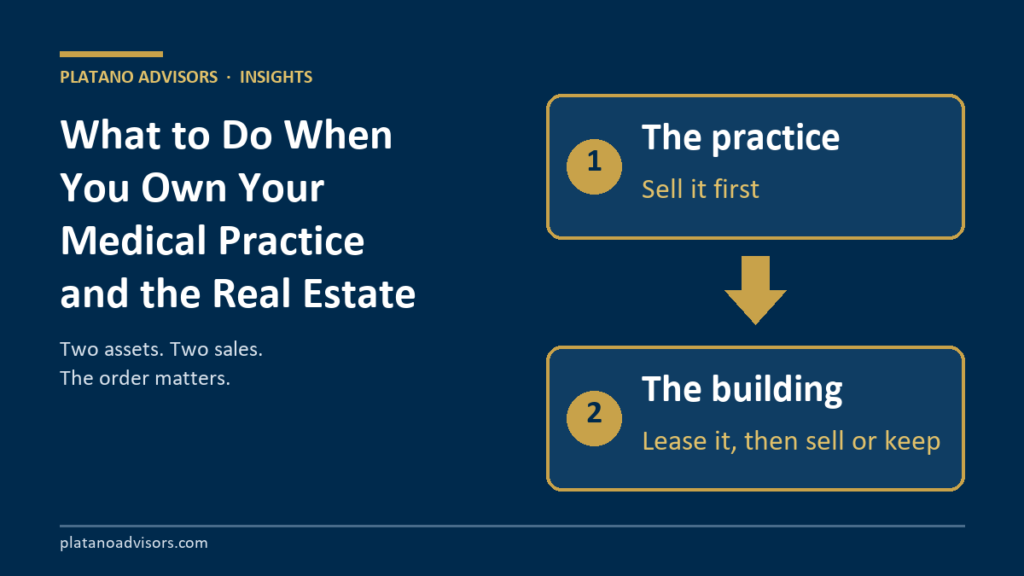
If you own your medical practice and the building it operates from, you own two assets, and selling them is two transactions. They can be done at the same time or years apart, to the same buyer or to two different ones. Each combination changes what you get for each asset and how much risk you carry in between.
This guide walks through what to do: how the two sales differ, the ways they can be combined, and what has to be in place so each one supports the other. It also includes our recommendation on the order, which is the question we get asked most.
Two assets, two transactions
The practice sale and the real estate sale are different deals, even when they close on the same day.
They are priced differently. A medical practice is valued on its earnings. A medical office building is valued on the rent it produces, or, if it has no tenant, on its square footage and what a buyer thinks it would cost to convert.
They are financed differently. A loan to buy a practice is underwritten on the practice’s cash flow. A loan on the building is underwritten on the lease. Under the SBA 7(a) program, a loan for the practice alone amortizes over a maximum of 10 years, while the real estate portion can run up to 25 years, and if 51 percent or more of the loan goes to the real estate, the entire loan can run 25 years. The full financing math is in Selling Your Medical Practice With the Building.
They attract different buyers. Physicians buy practices. Some of them also want to own the building. Strategic buyers, the groups acquiring several practices, generally lease. Real estate investors buy buildings, and what they want is a building with a tenant in place.
They are taxed differently, and if the building is held in a separate entity from the practice, as it often is, that entity is a second seller with its own contract and its own closing. Your CPA should be in the conversation before either asset is listed.
The ways the two sales can be combined
There are more combinations than most medical practice owners expect.
- One buyer, one closing. The practice buyer also buys the building, and both transfer together.
- One buyer, two closings. The practice buyer signs a lease at closing and buys the building later, sometimes under an option written into the lease.
- Two buyers. The practice goes to one buyer, who becomes the tenant. The building goes to a real estate investor with that lease attached.
- Sell the practice, keep the building. The practice buyer becomes your tenant and you hold the building for the rent.
- Building first. The building is sold to an investor and leased back, and the practice is sold afterward.
Which of these you end up in depends partly on the buyer who shows up. What you control is the order you go to market in, and that is where the recommendation comes in.
Our recommendation: sell the practice first, or both together. Not the practice after the building.
Sell the medical practice first, then the building. Or sell both to the same buyer in one transaction. What we do not recommend is selling the building first and the practice afterward.
The practice is the slower sale, so it goes first. Finding, qualifying, and closing a buyer for a medical practice takes longer than selling a leased building. There is a valuation to build, a confidential marketing process to run, buyer interviews, a letter of intent, diligence, financing, and the credentialing and payer work that has to be timed around closing. A medical office building with a tenant in place is a more standard asset that real estate investors underwrite on the lease.
You keep control of the building while the practice sells. No landlord has been introduced, no lease has been signed by anyone but you, and nothing about the real estate is fixed before you know who the practice buyer is. You are selling the harder asset from the strongest position you will ever hold.
The practice sale produces the tenant the building needs. Whoever buys the practice is going to occupy your building, either as its new owner or as its new tenant. The moment the practice closes, the building goes from an owner-occupied suite with no lease to an income property with a tenant.
Why not the building first. Once the building is sold, you are a tenant, and the terms of your lease were set before you knew who would buy the practice. The practice buyer inherits that lease, and the new landlord usually has a say in the assignment, which puts a third party between you and your practice sale. You have also given up the option of offering the building to the practice buyer, who may have been the best buyer for it. There are structures where the building sells first, and they are used in specific situations. We are glad to talk through them. As a general rule, though, the practice does not sell after the building.
Step 1: Sell the practice, and offer the buyer the building
List the practice and run the full buyer process. Every serious buyer is offered the building as well.
Why a practice buyer may want it. Financing. A loan that covers both amortizes over a longer schedule than a practice-only loan, which means a lower payment per dollar borrowed and more purchase supported by the same cash flow. The buyer also owns the walls: no rent escalations, no renewal risk, and every payment builds equity.
Why a practice buyer may pass. It is a bigger check. Buying both means more equity down and more debt, and some buyers who can comfortably carry the practice cannot carry the building on top of it. Strategic buyers generally do not want to own real estate at all.
So the pool of buyers who will take both is real, but it is smaller than the pool for the practice alone. If the practice buyer takes the building, you close both, and you are done. If not, you lose nothing, because the buyer you just found becomes your tenant, and that is Step 2.
Step 2: If the buyer only wants the practice, they sign a lease at closing
The buyer signs a lease on the building at the practice closing. You become the landlord. The lease does not need to exist before the practice sells; it is created as part of the practice transaction.
The lease is what turns the building into a sellable asset, so it has to be written for two readers at once: the buyer who is signing it, and the real estate investor who may buy the building later.
What the lease needs
- A term long enough to protect the buyer, and firm enough to price. The buyer paid for a practice whose patients know this address. The lease has to give them years of security, with renewal options only they can exercise. An SBA lender will generally require the lease, including those options, to run at least as long as the buyer’s loan. Investors, on the other hand, pay for firm years, not option years.
- Rent at market. Not what the practice was paying you, and not a number that flatters the building. Rent above market comes straight out of the practice’s earnings, and the buyer’s lender underwrites the actual lease payment. Rent below market cuts the building’s value. Expect the buyer to negotiate rent as part of the practice price. Hold the rent at market and negotiate the price instead. The rent follows you into the building sale. The price does not.
- Assignment with consent. Assignable to a successor practice with the landlord’s consent, which the lease says cannot be unreasonably withheld, with the original tenant staying responsible unless released.
If you plan to stay on with the practice after closing while also being its landlord, the lease has to hold up as a written, fair-market arrangement under the federal physician self-referral rules, so have healthcare counsel review it before it is signed.
We are not attorneys, and nothing in this article is legal advice. The lease is a legal document and should be drafted and reviewed by your attorney. If you need one, we are happy to make an introduction.
Step 3: Sell the building with the tenant in place, or keep it
Selling a medical building with a tenant in place
Investors price a leased building on its income, and a long lease to a medical tenant usually clears a higher price than the same building empty. A vacant medical suite is priced on square footage and the cost of converting a specialized build-out; a leased one is priced on the rent the practice buyer just committed to. The exception is an owner-user, another practice that wants the space for itself. That buyer needs your practice buyer to leave, so it is not a path you want.
Because the practice sold first, you arrive at the building sale with the tenant in place, the rent set at market, and the income proven. Sell the practice first, and it produces the tenant. The tenant produces the lease. The lease produces the building’s price. Each step sets up the next.
Keeping the building for rental income
You can also sell the medical practice and keep the building. Some medical practice owners prefer the monthly rent to the lump sum, and a long lease to a strong medical tenant supports that. Write the lease to the same standard either way, so the option to sell later stays open.
A middle path is a lease with an option to purchase: the practice buyer leases now and holds a right to buy the building later at a set price or formula. It gives the buyer a route to ownership without the larger day-one check, and it gives you a defined exit from the real estate.
How Platano handles it
Platano Advisors is a healthcare M&A advisory firm and a licensed Florida real estate brokerage, so we can represent you on the practice sale and on the real estate sale, whether they run together or separately. Sales where we sell both the medical practice and its real estate are a significant part of the transactions we close. If you own both and are thinking about retirement, we would be glad to talk through what the sequence looks like for your situation.
Frequently asked questions
Should I sell the medical practice first or the building first?
The practice first, or both together to the same buyer. The practice is the slower sale, you keep control of the building while it runs, and the practice buyer becomes either the buyer of the building or its tenant. We do not recommend selling the building first.
Can I sell the medical practice and keep the building?
Yes. The practice buyer signs a lease at closing and you hold the building as an income property. Write the lease to investor standard anyway, so you can sell the building later without renegotiating it.
Do I need a lease in place before I sell the practice?
No. The lease is created as part of the practice transaction. The buyer signs it at closing, and the building is then sold or held with that lease attached.
What does the buyer’s lender require in the lease?
An SBA lender will generally require the lease term, including renewal options the tenant controls, to run at least as long as the practice loan, at a rent the practice’s earnings can cover.
Can the same buyer purchase both the practice and the building?
Yes. A loan that covers both can amortize the real estate over up to 25 years versus 10 for the practice alone, which lowers the buyer’s payment. The pool of buyers willing to take both is smaller, so the building is offered to every serious practice buyer with the lease path ready behind it.
Should the building be included in the practice’s sale price?
No. Price them separately. The practice is valued on its earnings and the building on its rent, and one blended number lets a buyer discount the asset they understand least. Even when one buyer takes both, the purchase agreement allocates a price to each.
Who buys a medical office building with a lease on it?
Medical office real estate investors, local commercial investors, and sometimes the practice buyer. What they price is the lease: the tenant’s commitment, the firm term and options, and market rent.